Dealing with ADHD Effectively


In this episode of the Health Check podcast, Dr. Winslow reveals that he suffers from attention-deficit hyperactivity disorder. No-one would begrudge you your raised eyebrows, least of all him. After all, it is precisely his duty to educate you about ADHD.

Dr. Winslow joined journalists Joyce Teo and Ernest Luis at The Straits Times’ podcast studio, where the duo court the expertise of medical professionals to inform and enlighten. Armed with myriad perspectives, Dr. Winslow availed his own brain to help demystify ADHD.

It wasn’t until Dr. Winslow began to see the parallels between his childhood behaviour and those of his clients with ADHD, that he realised he too had the disorder. It didn’t seem to bother him too much – he laughs at being chided by his son’s teachers for his pride in his son’s ability “to pass exams exactly the same way” as he did, without paying attention in class.

Dr. Winslow says that in the brains of people with ADHD, communication between cells is difficult – that’s how they are more likely to lose focus, become distracted, or give in to impulses. Singapore’s regimented education system doesn’t help either. Students with ADHD face real disadvantages, in their inability to sit through lessons, and in the way educators see those who refuse to (or simply can’t) pay attention for long stretches.

Dr. Winslow recalls being forced to run laps around the school as a child by his teachers, who had hoped to wear his indefatigable energy down into submission in time for class. He admits that it worked surprisingly well. ADHD can be managed, as he would learn.

It is unfair to say that ADHD is “not a real disorder”, and that one merely needs to “concentrate on overcoming it”. That just doesn’t make sense. ADHD is a medical condition that can be tackled with correct tools and the right will. Dr Winslow says it’s possible to address the few big symptom groups (Hyperactivity, Impulsiveness, and Difficulty with Distractibility) with practical advice in the right contexts. For example, you might teach your always-tardy child about time management with to-do lists.

Dr. Winslow says parents should try and come to terms with their child’s ADHD, or risk more worrisome aspects spilling over into adulthood. Adult ADHD often comes packaged with low self-esteem, where inability to complete tasks due to inattention becomes internalised as laziness in a self-defeating cycle.

Overcoming ADHD is easy, says Dr. Winslow, when you understand this maxim: “The more you understand the complications brought by your limitations, the more you can do to manage your symptoms.” It’s an expansion of the classic “knowledge is power”.

Once you begin to appreciate the ADHD brain for its quirks, advantages become more apparent. The meandering thoughts of people with ADHD often help them develop novel solutions to problems – “thinking outside the box”.

The doctor’s recommendations? Don’t panic, try to understand ADHD, and don’t forget the fish oils!

Listen to the Health Check podcast over at The Straits Times website, or search for it on your favourite podcast platform.

Can a Sexless Relationship Be Healthy?

If you’ve stopped having sex in your relationship and it’s bugging you, read on.

According to research, Greece is the most sexually active country in the world. Amid the white-washed buildings and servings of moussaka, every mature citizen there is reported to be having sex at least once every two days. Brazil comes a close second, with Russia not far behind. Across the globe, we are conditioned to believe that we should all be having as much sex as possible. But what if you’re not having sex and are in a sexless relationship?

Sex in a relationship comes with undeniable health benefits that extend well beyond the bedroom. It’s proven to lower blood pressure, increase immunity, lessen pain, improve sleep, ease stress, and much more. Yet despite the positive attributes, not everyone couple are getting down to it. There are varying definitions of a sexless marriage or sexless relationship, but it’s most quoted as being any partnership where sexual intimacy occurs 10 times or less within a year period.

couple-enjoying-book-on-bed-importance-of-sex-in-a-relationship.jpg

Ebb and flow

Perhaps you used to be a do-it-daily type of marriage. Maybe a few times a month sufficed. There are couples who are happy to not have sex for their own reasons such as illness, early stages of motherhood or not being in the same country. If there has been a change in your sexual frequency as your relationship has developed, that’s also perfectly natural.

“Sex ebbs and flows over time and as we age, but the reasons it starts to stall are many and include everything from health issues to lifestyle factors,” says Andrew Da Roza, psychotherapist and sex addiction specialist at Promises Healthcare. “It can result from a great many combinations of variables such as sexual dissatisfaction, an emotional disconnection with your partner, poor communication, work stress, or simply a lack of privacy, space and sleep.”

Andrew also highlights how human beings are essentially a paradoxical bunch. “We desire nurturing and supportive relationships that give us a sense of safety, security, familiarity and predictability. Yet we also seek novelty, excitement, mystery, unpredictability and a journey of transcendence in relationships. From this perspective, it makes sense that couples can come to a ‘sexual standoff’.”

It’s here that things get complicated: without sufficient communication, side-effects of a sexless relationship for a couple can include anger, frustration and resentment in one or both people. “A lack of sex can perpetuate feelings of rejection, low self-esteem and insecurity that you’re no longer attractive to your other half,” says Winifred Ling, couples therapist and relationship coach at Promises. In the worst case scenario, should one partner feel they’re not getting their needs met, it can lead to them seeking sexual satisfaction elsewhere.

Get back on track

While this sounds pretty grim, the good news is that your sex life can be revived if you both want it. As with all relationship issues, communication is key. “Choose a time to talk when you’re both calm and in a good space to identify how you’re feeling about the lack of sex,” suggests Winifred. “Be open to speaking out sensitively and honestly — broach when and how often you’d like sex to take place, what’s good in your current sex life and what needs to be improved.” If this is tricky to do together, seek a neutral third party in such as a psychologist or councellor to facilitate the dialogue and provide a safe space for discussion.”

Of course, once you’ve spoken you’ve got to walk the talk. “Your actions have to be consistent with your words,” says Winifred. “The worst thing is when one partner feels invisible and alone in a relationship even though you’re physically together. Revive loving feelings in a sexless relationship by remembering what you love about one another, and affirm each other through words and actions such as hugs and touch. Show kind and generous gestures regularly (a kissy face emoji or a quick message keeps the connection going). Do the small things often to show you care and see your partner.”

Also, be mindful that sex doesn’t always have to be limited to intercourse, and sexlessness doesn’t have to mean a loss of intimacy. Physical intimacy, including cuddling, oral sex, manual stimulation and sharing sexual fantasies, contribute to bringing you closer which can then lead to a more fulfilling sex life.

“Ultimately, no one should tell you what to do in a relationship,” says Winifred.  “So, if you’re having less sex than you think you ‘should be’ and are fine with it, there’s nothing to be worried about. What makes for a happy and healthy sexual relationship is meeting the needs of both partners and bonding as a couple. Only you get to decide if you fit into society’s definition of a sexless relationship or not.”

If you are having communication problems, issues with sexual arousal or painful sex within your relationship, it might help to seek support from a trained professional.


*This article first appeared on The Soothe’s website.

Supporting Your Child’s Learning Needs

If you’re a parent who believes in taking a proactive approach to your child’s education, then you’ve probably realised by now that comparing your young one to the school’s resident whiz kid(s) is ill-advised. There is truth then, in this kernel of wisdom: “Every child is a unique gift from God”.

Understanding how your child takes in information, assimilates it, learns, is perhaps the first step to making their education a better experience for them. When parents start getting a grasp of what their child’s preferred way of learning is, they can start taking steps to work with that style of learning, instead of foisting the next flavour of the month upon their child. Individual learning styles don’t necessarily dovetail with the school’s pedagogy – but that’s OK. This just means that you’re blessed with more opportunities to help your child grow up with the values and convictions you hold dear.

Conventional wisdom tells us that people generally fall into one of three categories – visual, auditory, or kinesthetic learning. But before you pigeonhole your child into one of those convenient boxes, it is worth noting that while a child may have a dominant learning style, a combination of all the styles is required to learn about the wonderful, wider world that they’re growing up in. Once you have figured out their style, you can then begin to take steps to ensure that they have ample opportunities in the classroom and at home to take advantage of that particular style.

However, there are some children who constantly struggle when they are subject to the traditional classroom setting. Despite your efforts to supervise and coach them, they might continue to face persistent difficulties with reading and writing skills, as well as attention and behavioural regulation in terms of their academic performance.

A child with learning difficulties is affected in different ways, with the impact ranging from mild to moderate or even severe, with symptoms surfacing when the time comes for them to learn literacy and numeracy skills in the classroom. Children with learning difficulties are at risk of developing low self-esteem, which in particular is a consequence of the condition going undiagnosed and/or untreated. Imagine a dewy-eyed child who, with all the innocence of  youth, proudly strives and strains to do well at school – yet never reaping a jot of acknowledgement. Imagine (or remember) what it feels like to have the purity of childlike endeavour constantly rebuffed by the shame of underperformance. To have effort always met with negativity is tough for even the most motivated child, which may lead to the development of a poor self-concept that ends up causing further social-emotional issues in future.

All children, learning difficulties or not, need love and support for them to cultivate a strong sense of self-worth, build confidence and develop resilience. In seeking ways to help your child who has a learning difficulty, bear in mind that your role as a parent is not to “cure” the difficulty, but to arm your child with the social and emotional tools they will need to work through challenges and develop strategies for compensating with their difficulties. In the long run, your child will emerge stronger and more resilient.

Even though everyone’s been a kid before, I know that the new and bewildering responsibilities of parenthood can sometimes make us forget what we, as children, wanted to have for ourselves. I’ve outlined some tips which can be invaluable to our efforts to support a child with a learning difficulty.

  1. Knowledge is power – learn everything you possibly can about your child’s learning difficulties and needs.

Doing your own research and keeping abreast of the new developments in evidence-based learning and behavioural interventions not only helps your child, it helps to foster a sense of solidarity with your child. The more you know about your child’s needs, the better you are equipped to help your child. Start with your child’s teachers and consult with professionals (e.g. educational psychologists, school psychologists, or child clinical psychologists) who are best positioned to work together with you and your child in this journey. Collaborating with your child’s school teachers and fostering a good relationship with them helps in the overall understanding of your child’s needs – this facilitates consistency between home and school, which is particularly essential for children with challenging behaviour.

  1. Be an advocate for your child by raising awareness.

While society has made great strides towards the goal of inclusivity, awareness of special education needs and learning disabilities is still limited (but growing). Embrace your role as a proactive parent, taking responsibility not only for your child’s welfare but also contributing to the child who does not have a dedicated guardian in their life. Yes, your journey will be fraught with challenges and frustrations, but always remember to remain calm and to persevere. We often don’t realise just how much children internalise behaviour and views that they perceive in their parents. As a parent, you are entrusted with the very delicate task of moulding a young mind. Your healthy optimism, perseverance, and sense of humour doesn’t just benefit you – it positively influences your child to be a self-advocate, which is a very important goal for a parent in these circumstances.

Some parents choose to hide their children’s learning difficulties in secrecy, for fear of stigma or unjust treatment by others. They might honestly feel that they’re serving the best interests of their child. On the contrary – it is this very lack of understanding and awareness from family and friends that causes the misattribution of a child’s developmental needs to ‘laziness’ or ‘poor parenting’ or ‘mischief’. By shining a light on the condition, you help others develop empathy and come to be more supportive of your child. Within the family, siblings might feel that there is more attention and preferential treatment towards the brother/sister with learning difficulties, despite being aware of their condition. Hence, it is also important for parents to reassure all their children equally that they are loved, to provide support to their work, and to include them all in routines for the child with learning difficulties.

  1. Focus on your child’s strengths, not just weaknesses.

No one is defined by disability or need. And no one is perfect either. As you embrace your child’s flaws, celebrate their strengths in the same breath. As with all other human beings, a child with learning difficulties too will come into their own personality, interests, strengths and weaknesses. Focus on the gifts and talents which your child is blessed with, and help them to nurture their areas of strengths such as in activities they excel in.

  1. Praise effort rather than outcome.

Children with learning difficulties may not always excel academically, and if they do, they likely have put in a lot more effort than their peers to have achieved a similar good grade. Acknowledge the effort made, which deserves recognition – no matter if the child has gotten the answer right or wrong. Your child is demonstrating courage when they try out new approaches to assignments and study strategies, and if you want them to learn from mistakes and be receptive to feedback, credit and praise must be given where due. It will take time for new practices and interventions to work and for new skills to be acquired, so bear in mind to focus on the long term goals, and to break larger tasks down into smaller, more manageable milestones which can be spaced out over time.

Everyone’s definition of success is different, but the aspirations you have for your child probably extend well beyond the fulfilment of good grades. Working with parents, it has been my experience that most, if not all, express the desire for their child to lead an independent life, in which they are capable of providing for themselves, and above all else, to be happy. This being the case, then success in life definitely isn’t based on just academic success, but rather on things like having a sense of self-worth, the willingness to ask for and accept help, the ability to bounce back in the face of adversity and the emotional depth to form healthy relationships – values and qualities that are not quantifiable like the metric of exam grades.

  1. Keep your child motivated.

As school is most likely a source of frustration for your child who puts in much more effort than in proportion to the reward of good performance, it is important to find something in school that brings your child enjoyment, that they are motivated to pursue without much prompting. Sometimes, to taste the fruit of serendipity, one must eschew his comfort zone. This may involve having your child participate in a CCA of their choice, attend camps or other school-related activities, and encouraging your child to have good relationships with peers and teachers. It can be difficult to motivate your child to learn, and to invest time in subjects which already make them feel inferior and bad at. You will probably meet less resistance if you start from your child’s level of ability, carefully choosing lesson topics that already are of interest to them. Give them some measure of autonomy to choose how they study or complete homework – building in breaks and breaking down challenging tasks into smaller chunks gives them ownership in the crafting of their own timetable, helping to keep them motivated to follow through with their plan.

Finding a role model who has flourished in spite of their learning difficulties can show your child that success is attainable, and that it is their own choice not to allow their current difficulties to define them. Celebrity, athlete, friend, neighbour or pastor, the only requirement to those role model shoes is that your child feels comfortable talking to them.

  1. Encourage healthy lifestyle habits.

Stress may manifest differently in children than in adults. While some signs may be more overt, such as trouble sleeping, agitation, acting out, or meltdowns, others may retreat inwards – shutting down, spacing out, withdrawing and isolating. Even as adults ourselves, we may lack the prescience to recognise that our internal systems are under stress, let alone children who have not yet matured into such skills. Hence, it is your responsibility to be vigilant of signs of stress in your precious one.

Your child’s eating, sleeping and exercise habits are also vital to their overall learning ability.  With a healthy routine which incorporates a balanced diet, quality sleep and sufficient physical activity, children will be better able to focus and concentrate.

Other than the physical, paying attention to your child’s emotional needs is also important. When they are faced with the frustrating challenges presented by their learning difficulties, allow them to express their feelings in a safe space. Validate them by acknowledging that the cause of their gripe is an issue, but be careful not to coddle them into poor self-restraint. Be ready to listen when they are ready to talk, and be a grounding, reassuring presence which helps their mind integrate with their body, and re-orient into a sense of calm.

Above all, remember to take care of yourself! The uniquely sacrificial dint of parenthood sometimes diverts needed attention from our own needs. If you are to project an empathetic sense of warmth, you will first need to cultivate self-compassion, and allow yourself the space to tend to your own needs. The quality of support you are able to provide to your child is dramatically affected by your own levels of stress and exhaustion. Parenting is a full time job, but don’t let yourself burn out emotionally.

In order to do this, you need to be mindful of your own limitations. You are the best gauge of when to rouse the oarsmen to right your ship. If you have a supportive spouse, or friend, or family member, take heart. Lastly, there is great benefit in the solidarity of support groups, which serve as useful support and also reminders that you are not alone in your unfolding journey!

How Psychological Testing Can Help Your Child

Raising a child is demanding – their emotions and personality trait can change frequently. As a parent, how can you tell if your child’s behaviour is part of growing up or a cause for concern?
Child psychologists at Promises, Tan Su-Lynn and SC Anbarasu speak to the editorial team at ANZA about psychological tests for children and adolescents which help parents better understand the strengths and challenges their child has in areas of cognitive, behavioural, learning and socio-emotional functioning.
Learn more about the types of tests and what goes into one.

As parents, we all want the best for our children. We naturally see the good in them and marvel at their every new development and discovery. However, raising a child can be demanding. Even under the greatest circumstances, their emotions and personality traits can change frequently, and it can be difficult to pinpoint when certain behaviours are typical or might need special attention.

Just like us, children experience a huge range of emotions (some more adorable than others!). They can be sad, anxious, aggressive or irritable. They can be restless, reclusive or downright grumpy. In most cases, these feelings are perfectly healthy, but how can you tell if your child’s mannerisms are a part of growing up or a cause for concern?

Promises Healthcare, Psychiatric & Psychological clinic can help to put your mind at ease with their psychological tests for children and adolescents. Carried out by their expert team of senior child and educational psychologists, these evaluations can help parents to better understand the strengths and challenges their child may have in areas of cognitive, behavioural, learning and socio-emotional functioning.

Tan Su-Lynn, Senior Educational Psychologist at Promises

Why take a psychological test?

While the idea of psychological tests for children might sound daunting, they can be essential in helping parents to make educated choices and implement strategies to ensure a child is getting the right support. “Intelligence – sometimes referred to as the Intelligence Quotient (IQ) – includes cognitive functioning, intellectual ability, aptitude, thinking skills, and general ability,” explains Senior Clinical Psychologist at Promises, S C Anbarasu. “Based on the type of assessments used, trained psychologists can obtain a more in-depth understanding of a child’s challenges. Some potential issues that can be detected include emotional or behavioural problems, or delayed learning with writing, spelling, maths or reading. Testing also helps to identify the presence of autism, ADHD or dyslexia.”

Says Tan Su-Lynn, Senior Educational Psychologist at Promises, “When a child is observed to have difficulties with their learning or behaviour in school or at home, this may suggest the possibility of a learning or behavioural disorder. Severity of the difficulties should also be taken into consideration, such as whether they impact their social, home and/or school functioning. Psychological testing can obtain a profile of a child’s strengths and areas that require support.

Reasons for a psychological test can include:

  • Learning difficulties or delays (for example, difficulties with spelling, writing, reading)
  • Emotional or behavioural problems in the classroom or home
  • Admission to special educational programmes
  • Increased understanding of a child’s learning style
  • Concerns regarding possible attentional difficulties
  • Underachievement
  • Giftedness

Senior Clinical Psychologist at Promises, S C Anbarasu
                                                                                                                                                                                                     

What are the tests and how do they work?

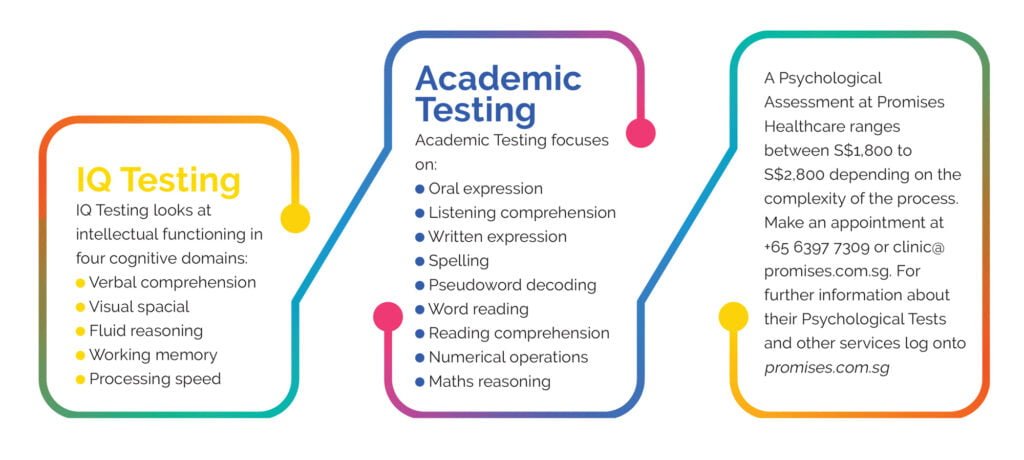
Depending on your concerns and your child’s needs, there are two types of psychological tests for children available at Promises to ascertain a child’s profile. “The IQ test measures a range of cognitive abilities and provides a score that is intended to serve as a measure of the child’s intellectual abilities, overall thinking, reasoning skills and potential,” explains Su-Lynn. “Our Academic Testing assesses areas in language, reading, writing, mathematical skills, comprehension and fluency.”

After an initial consultation period, both assessments take place in stages. As each one lasts approximately 6-12 hours, sessions are spaced out to reduce fatigue and distraction. There are no scary school exam style set-ups here: each test involves fun problems, puzzles and questions. “Generally, most children enjoy the testing sessions as it’s an engaging process,” says Anba. “To make sessions as stress-free as possible, we have regular breaks so they can play with their favourite toys. Tasks that involve using hands to construct or fingers to point at pictures appear to appeal the most. Parents are welcome to join their child throughout for support.”

Once completed, a feedback session is arranged to discuss the outcome and provide parents with the opportunity to ask questions. Parents also receive a comprehensive written report with recommendations for home and school settings. Continues Anba, “With psychological tests for children, we can address potential issues early and hopefully prevent the child from feeling demoralised, stressed and anxious in the future.”

When parents and teachers work holistically with Promises, everyone receives a better understanding of the child’s behaviour and game-changing solutions to bring them a brighter and happier future.

Promises Healthcare_Psychological Testing Diagram

Discover more at Promises Healthcare, Psychiatric & Psychological clinic.#09-22/23, Novena Medical Center, 10 Sinaran Drive, 307506. Tel: +65 63977309


*This article was first published on ANZA’s website. 

Improving Mental Health at Work

Workplace mental health is becoming an attractive proposition for employees and employers alike. Having a mentally healthy environment can help employees become happier, more productive and motivated individuals. Yet, mental health issues are often swept under the rug, simply because they can be touchy subjects to handle. In Singapore, the Health Promotion Board (HPB) drew from data culled from 1000 respondents, and found that compared to an n representative of Singapore’s general population, the mental well-being of working adults was found listing – 13% more worse off, to be exact. In addition, another survey also found that 1-in-6 working adults experience “a relatively high level of stress”, compared to 1-in-10 non-working adults who expressed the same concerns. This stark contrast makes us wonder – Does working for ‘The Man’ make us miserable?  Does that mean we can curtly reply “Money”, when the interviewer wants to know why we want that job?

Singapore is notorious for a fast pace of living, a country where your career helps to define you. With career advancement already firmly ensconced within our list of priorities (for the average Singaporean, at least), many tend to devote a good part of their waking hours to work, with less and less time being set apart for leisure and recreation. It makes sense then, that we should look to the workplace as a concept just as deeply implicated in our happiness (or lack thereof) as home and family.

Employers who pay scant attention to the mental health issues of their employees will soon find that such a business model doesn’t pay long-term dividends. In fact, it may end up costing them – there are countless studies out there detailing and actually quantifying the monetary costs of poorly managing workplace mental health. Intuitively, we’ve already known this without having to be told – if the only free time you’re allotted for a restroom break has to be taken during your 10-minute lunch, then you’ve probably seen fit to leave your bootstraps in the toilet. Employers, too, know the sting of cynical, burned out employees making full use of paid medical leave.

In this case, not only does the organisation have to pony up the employee’s sick leave entitlement, they also have to incur the opportunity cost of the work the employee would have contributed if they were present and productive. The organisation thus suffers financially. Moreover, mental health issues can precipitate workplace bullying and harassment. Employees may start feeling disempowered, demotivated and dissatisfied with their jobs. The overall workplace morale takes a plunge.

In light of this, we have to acknowledge that we, more often than not, overlook an extremely important factor which makes or breaks the mental well-being of employees in the workplace.

I am reminded of the movement of person-centered decision making in the workplace by the pithy saying: “Nothing About Me Without Me”.¹ It serves to remind people that even though individuals with mental health issues may be deprived of 100% lucidity and perspicacious decision making abilities, others should, as a principle, accord them the same respect, and not make any decisions without consulting with them. This is especially so if these potential choices might affect the employee’s quality of life. When making considerations which may impinge on another’s life, it’s only good manners to make sure that everyone affected is a stakeholder.

Mental health issues tend to attract the kind of hushed conversations that we want to avoid. It’s simply improper to gossip about such deeply personal issues. Conversations regarding the affected individual shouldn’t take place without their “blessing”, either. If I were to take a charitable interpretation of such water-cooler talk, I might say, after all, people may not know the right approach to handle these situations, or they may simply be misguided in their good intentions!

Some useful guidelines for professionalism at the workplace. If you are, for example, a HR-manager and suspect that an employee of yours requires help with a personal mental health issue, do not:

  • Apprise superiors of his condition without seeking his permission first
  • Try to “ease his burden” by lessening his workload in an attempt to “help” him cope with his condition without consulting him beforehand

Instead, as soon as any discussion is started about the individual, he should be brought into the fray and  not be left in the dark. The point here is about giving back control to the person in question, and allowing him to understand that he is still equally respected regardless of his mental health.

What happens if these pointers are neglected? Unfortunately, diminishing the employee’s workload without consulting him first may chip away at his sense of self-worth, since he is stripped of the ability to demonstrate his capabilities. Moreover, having your superiors talk about you behind your back can in some ways, make you feel discriminated against for having a mental disorder. This breeds a sense of distrust amongst colleagues, which erodes the fabric of work cooperation. Not respecting someone’s dignity and right to make decisions can also hinder his/her mental recovery process. Needless to say, such workplace environments are deeply unprofessional outfits which detract from productivity and dignity.

We should thus focus on what we can do to make our workspaces better places, and mentally healthier ones. We should start taking “Nothing About Me Without Me” seriouusly. We need to start recognising its importance to a well-oiled outfit and how it helps foster pride and dignity. In fact, we should help this principle take root at the organisational level, such as including people with past experiences of mental health issues in the development and expansion of workplace mental health policies, or seeking their input when it comes to planning activities in service of mental well-being. Policies centered on transparency and proper communication should also be developed as adjuncts to ensure that the organisation is committed to making sure employees’ voices are heard when it comes to issues of mental health and their careers. If more organisations are willing to take these steps, there’s no doubt our workplaces will slowly become more conducive and nurturing environments. How is your company contributing towards making your workplace a mentally healthier one? Share your thoughts in the comment section below, so we’re all better off for having heard these ideas.

¹ Golding, E. and Diaz, P. (2020) Mental Wealth. New York: Morgan James Publishing.

Managing OCD and ADHD Medications for Kids

Are children being over-medicated for mental health issues? We spoke to DR ADRIAN LOH, Senior Consultant Psychiatrist at Promises Healthcare, who explained how doctors balance the use of drugs like or ODC or ADHD medication for kids with a duty of care in diagnostics and treatment.

Dr Loh’s general observation around healthcare in Singapore is that both parents and doctors remain cautious in the use of medication in children and adolescents being treated for mental health issues.

Yet, while it’s appropriate to exercise due diligence before starting medication – especially in view of possible side effects – there is a flip side when they’re withheld without good reason.

adhd medication for kids

“This may be due to insufficient understanding of the medication,” says Dr Loh. “There may be unfounded fear of ‘addiction’ or concerns about costs of treatment, for example, or it could be because of the persistent underlying social and cultural stigma around mental illness.”

What to take into account when considering medication

The decision to use medication, he says, should be a carefully considered one, taking into account a few key areas.

  1. In making a diagnosis, a good practitioner should also identify relevant factors that influence a child’s mental health condition, including their age and education level, the presence of other medical conditions, underlying temperament and personality traits, family and interpersonal relationships, as well as socio-cultural norms.
  2. There should be an assessment of the severity of the child’s symptoms and the level of distress caused to the child – and in some cases, to those around him.
  3. The practitioner should be able to confidently assess the impact of the condition across different areas of the child’s life.

For parents, stress around children’s mental health can be significant. For many of us, the tendency is to observe a child for signs of mental distress, but then wait to act. When we finally cannot intervene to help anymore as the child becomes a teen and even more inaccessible, we then realise it’s time to get professional help from therapists and psychiatrists.

From there, it can be an extended journey, according to Dr Loh. A patient may need months of therapy to unpack and get to the root of their fears, mood swings or erratic behaviour. Depending on the considerations mentioned earlier, the doctor will consider the use of medication to try to alleviate some of their symptoms at a suitable juncture.

“For example, a child could be diagnosed with mild ADHD (Attention Deficit Hyperactivity Disorder), but if there is a significant impact on their friendships or their ability to cope with schoolwork, and if other attempts at helping, such as classroom management, have been unsuccessful, it may be timely to introduce the use of ADHD medication for kids.”

adhd medication for kids ocd

Patient and parent responses

Dr Loh also notes that not all medication is going to “work” the way we want it to. Every patient responds to therapeutic drugs in a different way. “Some drugs that are used to treat mental health conditions may not have the intended effect and the doctor may then have to cycle through several different types to land on the right one. This can be distressing for the patient as well as parents, who can feel that the child is ‘over-medicated’.”

It’s a conundrum that requires patience from all involved, as not trying medication altogether may cause more harm, he says.

“Another illustrative case is with OCD (Obsessive-Compulsive Disorder). This is a condition that local and international studies have shown to be often characterised by a prolonged duration of untreated illness, extending even past a decade for some individuals. In many of the young people I’ve treated, my personal experience is that it would have been beneficial for them to have been started on medication much earlier in the course of their illness.”

At the same time, there are some instances where antidepressants may not be the most helpful solution. “Inappropriate use of medication is another valid concern,” says Dr Loh. “One example would be to ignore the underlying factors contributing to a child’s depressive symptoms. These could include unresolved grief after a death in the family, or feelings of helplessness or guilt about parents’ marital conflicts. In these situations, it’s wise not to offer antidepressants as a cure-all. Instead, offer counselling or other forms of therapies alongside the judicious use of medication to help the child in a holistic manner.”

In instances where parents describe “over-medication”, Dr Loh says that it could be possible that some children may have been offered medication without considering other alternatives. “When experiences of this kind are shared with other parents, it can lead to a perception that medication is overused.” He adds that if medication at a particular dose has been tried for a certain period and doesn’t result in an improvement of symptoms, this too can lead to an unwarranted generalisation that medication is ineffective.

Final word

It’s about taking the time to come to the right solution – because making or sticking to an inaccurate diagnosis can lead to the inappropriate use of medication. “If a teenager has symptoms of what we call hypomania (a less dramatic state of elevated mood) and those symptoms are missed and they are treated only with antidepressants, it can lead to a poor treatment response or even a worsening of what eventually can turn out to be a bipolar disorder.”

Mental health hangs in a delicate balance for both children and adults. It needs much more attention than we tend to give it, says Dr Loh – it’s all too easy to ignore the symptoms of unease and distress and block them with screen distractions. If you have concerns, he suggests speaking to a therapist as a key part of your self-care regimen.

About the doctor

Dr Loh is an experienced psychiatrist with a subspecialty focus in child and adolescent Psychiatry. He has a special interest in Obsessive-Compulsive Disorder and anxiety disorders, expertise in military and aviation psychiatry and a strong appreciation for the cross-cultural aspects of mental wellbeing.


This article was first published on the Expat Living Website on 30th March 2023 and written by Anna Murphy.

Preventing Suicide in Children: A Guide

The Samaritans of Singapore (SOS) reports that the number of suicides in Singapore rose 10 per cent in 2018, with suicides among boys aged 10 to 19 at a record high. Suicide mortality among youths and males is a “significant societal concern”, SOS said, highlighting that for every 10 suicides in 2018, at least 7 involved males. Among boys aged between 10 and 19 years old, there were 19 suicides last year – the highest since records began in 1991 and almost triple the seven cases recorded in 2017.

Suicide does affect children and adolescents, and avoiding the topic does nobody any favours – burying your head in the sand won’t help them learn how to get help if they find themselves needing it. One common misconception about the discussion of suicide is that talking about it plants the idea in people’s heads, causing children and adolescents to think about it. The simple truth is that parents won’t ever know if their child harbours suicidal thinking if they are too afraid to broach the topic. Suicidal behavior in children is complicated. It can be impulsive and associated with feelings of confusion, sadness, or anger. The so-called “red flags” people are cautioned to look for can be subtle in young children. While a young adult might say something along the lines of, “You’ll be better off when I’m gone,” in contrast, a child might say some something similar to, “No one cares if I’m here.”

Warning Signs

While the warning signs in children can be subtle, learning to identify potential red flags plays a crucial role in intervention.

Changes in baseline behaviour:

Take note of behavioural changes that aren’t short-lived.  While suicidal behaviour is often associated with symptoms of depression, you might also notice the following changes in your child:

  • Changes in sleeping habits (too much, too little, insomnia)
  • Changes in eating habits (overeating or eating too little)
  • Withdrawing from family and friends (social isolation)
  • Psychosomatic symptoms: headaches, stomach-aches, other aches and pains that can’t be explained

Changes at school:

It’s perfectly normal for children to experience ups and downs during the learning process, but a pattern of negative change can be a red flag that a child needs help. Make a note of the following:

  • Drop in academic performance
  • Decreased interaction with teachers and kids at school
  • Lack of interest in school
  • Refusal to attend school
  • Loss of interest in normal daily activities (playing, sports, co-curricular activities)

Preoccupation with death:

It’s natural for children to think about death at times, particularly when they are coping with loss or hear about tragic events in the news. Preoccupation with death, researching ways to die, and/or talking about their own death can be red flags. Watch for the following warning signs that involve thoughts about death:

  • Frequent questions about or looking up ways to die
  • Statements about dying or what will happen if the child dies (Examples: “You won’t miss me when I die, I wish I was dead, I won’t bother you anymore when I’m gone.”)

Feelings of hopelessness:

Children who have suicidal thoughts might communicate feelings of hopelessness for the future. They might also make statements about helplessness. These kinds of statements indicate that the child feels as if there is nothing to be done to improve their outcome, and no one can help.

Child-sized wills:

Some children give away their favourite possessions or tell parents, siblings, or friends who should get their favourite possessions. While talk of dividing up possessions might seem like fantasy play to parents, it can signal thoughts of suicide when combined with other changes in behaviour.

Writing or drawing about death or suicide:

Young children often struggle to verbalize intense emotions, but they are likely to take to the diary or drawing block to explore these emotions. Poems, stories, or artwork depicting suicide or, frequent writings and drawings about death should be evaluated.

Significant changes in mood:

Kids experience changes in mood as they grow and work through stressors, but significant changes in mood signal a problem. If your child suddenly shifts from calm and relatively happy to aggressive, completely withdrawn, or very anxious, it’s important to get help.

In addition to the warning signs that a child might experience suicidal ideation, there are also certain factors that can elevate the risk.

  • Previous suicide attempt (regardless of how serious)
  • Experiencing a loss (this can include grief and the loss of a relationship due to divorce or family discord or break-up)
  • Chronic bullying
  • Family history of suicide or suicide attempts
  • Violence or witnessing violence
  • Impulsivity
  • Acute rejection
  • Feelings of hopelessness
  • Feeling like a burden


Communication Tips with your Child 

Any signs of suicidal ideation or behaviour should be taken seriously.

Parents should ask specific, direct questions about suicidal thoughts – “Are you thinking about hurting or killing yourself?”

Parents should also talk openly about depression by asking questions like, “Are you feeling depressed or very sad lately?” These questions show your child that you understand and that you care. Conveying empathy in a time of emotional crisis is crucial. You may be concerned about saying the “right” thing. But the truth is that just having an open and honest discussion with your child can provide them with much-needed support.

Keep the Talk Age-Appropriate

  • Make sure that your child understands what you are saying and is not confused or bored by the discussion.
  • Use words that your child can understand. Words such as “depression” or “emotional reaction” are probably too complex for a younger child but may be appropriate for an older child or adolescent.
  • Try comparing your child’s depression to something that your child is already familiar with like a physical illness such as the flu or an ear infection.

Keep the Conversation Positive

  • Depression is a serious illness that causes emotional and physical pain, but try to keep the conversation focused on the positive.
  • By maintaining a positive and hopeful outlook in your discussions, you will avoid unnecessarily alarming your child.

Prioritize the Positive

Another important way to prevent suicidal behaviour is to prioritize interacting with your child in positive ways. Sometimes we get into a sort of vicious cycle with a child. The child does something concerning; the parent gets critical; the kid does something more concerning; the parents get more upset. All interactions turn contentious. Interacting in positive ways means doing fun things together, hanging out and chatting about things that aren’t controversial, that aren’t difficult.

Be Honest

  • Don’t make promises you cannot keep.
  • Don’t go into detail about topics that you are not certain of.
  • Do tell your child what you do know.
  • Make a list of questions to discuss with your child’s mental health professional.

Be Compassionate

  • Your child needs to know that you recognize and respect their feelings.
  • Even if you do not quite understand their thoughts, don’t dismiss their feelings.
  • Avoid comments like “What do you have to be depressed about?” or “Don’t be ridiculous.”
  • Dismissive comments can cause a child to hide their feelings or become defensive.

It may seem obvious to you that you love your children, and that they know you love them. But when they’re having a hard time, children need to hear over and over again from you how much you love them, and how much you care about them. It’s not good enough to just say, “You know I love you.” You need to convey that in small and big ways. These days, we all have so many things we’re juggling that our children can end up unsure of where they fit in, and whether you really have time for them. Let them know how important they are to you.

Be a Good Listener

  • Allow your child to talk openly and express their opinions and thoughts.
  • Avoid interrupting, judging or punishing them for their feelings.
  • Listening demonstrates that they have someone they can confide in help to sort out their feelings.

If there are any safety concerns, do not provide judgment or discipline; simply remove your child from immediate danger, do not leave them alone, and get them immediate help.

Never dismiss suicidal thoughts in a child and any suicidal thought or behaviour should be brought to the attention of your mental health provider immediately. If needed, bring the child to an emergency room or call an ambulance.

If for some reason the above options are not available, make a referral to the Samaritans of Singapore (SOS) by writing to [email protected], or calling its 24-hour hotline at 1800-221 4444.

The author hopes that the suicide prevention/awareness workshops he conducts at schools and corporations are doing some good.


Bibliography

https://www.channelnewsasia.com/news/singapore/suicides-number-2018-teenagers-boys-highest-11761480

https://www.health.ny.gov/prevention/injury_prevention/children/fact_sheets/10-19_years/suicide_prevention_10-19_years.htm

https://www.psycom.net/children-and-suicide

https://www.verywellmind.com/suicidal-thoughts-and-depression-in-children-1066661

https://childmind.org/article/youre-worried-suicide/

https://www.sos.org.sg/get-help/helping-someone-in-crisis

Psychological Testing: What You Should Know

Psychological evaluation is often helpful in understanding the strengths and challenges an individual may have in their cognitive, behavioural, learning and socio-emotional functioning.

At Promises Healthcare, we believe that “one size fits all” is not an approach that is applicable to the treatment of psychological disorders and challenges. We provide tailored recommendations for parents, teachers, and therapists so that interventions and accommodations allow each child to reach their potential.

IQ and academic testings can provide important information about a child’s cognitive strengths and weaknesses, academic needs, and preferred learning style. These can assist parents and children in making educational choices and implementing strategies to ensure that the child’s learning is appropriately supported.

Specific reasons for testing include:

  • Learning difficulties or delays (e.g. difficulties with spelling, writing, maths and/or reading)
  • Giftedness
  • Underachievement
  • Emotional and/or behavioural problems presenting in the classroom and/or at home
  • Admission to special educational programs
  • Increasing understanding of a child’s learning style
  • Concerns regarding possible attentional difficulties

What is IQ testing?

Intelligence testing is a method used by psychologists to measure a child’s intellectual capabilities. Intellectual assessment is a good indicator of a child’s potential. We use the Wechsler Intelligence Scale for Children, fifth edition (WISC- V). This is an individually administered instrument for assessing the cognitive ability of children aged 6 years to 16 years.

The WISC V is one of the most reliable and valid IQ testing instruments available and is the most widely used measure of IQ. The WISC V provided scores that represent intellectual functioning in four specified cognitive domains: Verbal Comprehension, Perceptual Reasoning, Processing Speed and Working memory.  During the testing session, a child is asked to solve problems and puzzles and to answer a range of questions. Generally, most children enjoy the testing session as it is an engaging process involving novel and fun tasks. Should parents have worries about their child’s emotional wellbeing during the assessment, raise it with us and, we can explore a workable collaborative plan to support you and your child during the testing process.

What is Academic Testing?

Academic Testing provided an overview of a child’s current performance across a range of academic domains. We use the Wechsler Individual Achievement Test (WIAT-III) with subtests including:

  • Oral Expression
  • Listening Comprehension
  • Written Expression
  • Spelling
  • Pseudoword Decoding
  • Word Reading
  • Reading Comprehension
  • Numerical Operations
  • Maths Reasoning

The assessment provides a rich source of information about a child’s achievement skills. Information obtained can then be utilized for intervention decisions.

The Assessment Process

The assessment is conducted in several stages:

  • An initial assessment with parent(s) is an integral part of our assessment procedure.
  • A time is set to administer the WISC 5 and the WIAT-III and other relevant tests. Usually, you may have to set aside about two or more sessions for approximately 6 to 12 hrs (excluding initial consult session) for testing, depending on the capacity and the needs of the child/person. Spacing out testing over several days can help some children overcome fatigue and stress.
  • A comprehensive written report will be prepared after all the testings are completed, based on the outcome of the assessment and testing process. The report will highlight relative areas of strengths and difficulties, with recommendations for home and school settings.
  • A feedback session will be provided to parents after the completion of the report. During this session, parents can be given an opportunity to clarify and discuss any concerns regarding the report.

Fees for assessments

  • The Psychologist conducting the tests will inform parents of the charges involved during the initial consultation session, based on the needs of the child/person and the different tests required.

Payment Plans

  • Payment plans are available for our testing procedures. Clients may choose to pay the full amount for testing at the end of the initial consultation or they may elect to pay in two payments. Like most of the private practices, reports will not be released prior to receipt of full payment.

Referrals/ For Information

Please do not hesitate to speak to our friendly reception staff at (+65) 6397 7309 if you wish to make an initial appointment. Alternatively, should you wish to clarify matters with me personally, you can leave your name and contact details with the reception at [email protected]

Understanding Childhood Emotional Neglect

As a child, how did adults around you react whenever you expressed your feelings? Did you grow up receiving that subtle message to wall up your emotions so they don’t get the better of you, or become anyone else’s burden? Childhood Emotional Neglect (CEN) is a topic often overlooked, and many fail to realise that it can eventually manifest into mood disorders or anxiety disorders if not dealt with appropriately.

Childhood Emotional Neglect occurs when our caretakers or parental figures fail to respond to our affectional needs suitably during critical stages in our development. An individual who grows up experiencing emotional neglect may experience a pattern of having his or her emotions being disregarded, invalidated or downplayed by others. While many of us may wonder, “What kind of parent doesn’t pay attention to a child’s emotional needs?” In reality, some parents may not actually realise that they have been shutting their child(ren) out emotionally. In Asian societies in particular, some parents are commonly labelled as “authoritarian” or “tiger parents”. These people may in fact perceive themselves to be giving the absolute best to their child, enforcing strict discipline and ensuring that their offsprings are well-equipped with the best skills to succeed in life. However, young children and teenagers may instead be overwhelmed by such demands, and feel as if their feelings were never considered or understood. Whilst we mentioned its prevalence in Asian societies, it is key to note that it is not merely limited to these children – many worldwide experience it too, making it an exceptionally important subject. With emotional neglect being a common feature in the childhood of many, it can become an undesirable shadow that follows us throughout our lives – eventually leading to undermined happiness and the lack of an authentic sense of self.

Delving into the matter at hand, Childhood Emotional Neglect (CEN) can come in two forms – active and passive CEN. Active CEN is when parents or caregivers actively act in a way that dismisses or denies the child’s emotions. For instance, a boy is sent to his room for crying over the death of his pet fish, and his parents complain of having an overly-dramatic son. When the child is being denied of his sadness and is receiving the message that his behaviour is unreasonable, this forces the child to grow up hiding his feelings, and at times struggling with fear and shame of his own emotions. On the other hand, passive CEN occurs when parents show a lack of care or validation regarding the child’s emotional needs. When parents fail to notice when the child is angry, upset, hurt or anxious, this gives off a subliminal message to the child that his feelings are irrelevant or not worthy of note. In any case, both forms of CEN are clearly detrimental towards one’s mental health.

Albeit not having a test or questionnaire that can help with a diagnosis for CEN, there are certain “symptoms” of CEN that may surface, be it in the later parts of one’s teenage years or adulthood.\

For one, individuals who have experienced CEN may find it difficult to prioritise their wants and needs, even if it’s something that would bring them great joy. It is innate for us to have desires and to just be aware of what we want and need. However, for someone who grows up having his feelings invalidated and cast aside, it could become a natural thing for him to keep his desires to himself. As such, even if opportunities do come along, these people would often fall through the cracks, most probably due to their inability to request for it upfront, or by allowing others to seize it instead.

CEN also causes one to start projecting any feelings inward, regardless of whether they are negative or positive ones. People who have experienced CEN are particularly predisposed to turning feelings of anger inwards, as they never learnt how to be comfortable with their emotions, nor how to handle them in a healthy manner. It is often said that nothing good comes from bottled-up feelings, and that is absolutely true.

Having pent-up feelings also mean that these individuals are not likely to seek help or lean into their support systems whenever things get tough, making them feel all the more isolated and vulnerable. Even at times when they are feeling deeply challenged by certain life events, they find themselves trying to cope all on their own, leading to unhealthy stress levels and anxiety. Unsurprisingly, the constant feelings of shame and inability to get in touch with one’s emotions will eventually lead to one losing sight of his or her strengths as well. As a result, poor self-esteem is sometimes a consequence of CEN.

While many individuals, including adults, fail to recognise the impacts of childhood emotional neglect on their lives due to its subtle nature, it is important that they get themselves back on track – to regain true happiness and greater self-esteem. You might have grown up devoid of your own emotions, but you need to recognise that facing them head-on will ultimately help you to cope with life events and for you to regain your sense of self.

Learn to start getting in touch with and embracing what you feel – both the good and bad. Identifying what you feel in certain situations will be a good step towards helping yourself cope with your environment and daily life. When challenges seem overwhelming, don’t feel afraid or ashamed of reaching out to your friends and family for help either. Even more so, if you ever feel like you’re losing control of your life and are derailing emotionally, seek professional help as soon as possible. While not everyone who grows up with emotional neglect ends up with mood disorders such as depression or anxiety disorders, there are certainly people who do. Don’t deny yourself of your emotions any longer, therapy might just be the solution to helping you learn the vital life-coping skills you never learnt as a child.  


References:

https://www.straitstimes.com/singapore/how-emotional-neglect-during-childhood-affects-ones-mental-health (Accessed 07/10)

https://blogs.psychcentral.com/childhood-neglect/2018/09/the-2-types-of-childhood-emotional-neglect-active-and-passive/  (Accessed 07/10)